Dry Eyes Through an Eastern Lens
If your eyes feel dry, gritty, burning, tired, or watery, it is tempting to see the problem as simply “not enough tears.” But dry-eye disease is usually more complex. Modern eye care recognizes it as a multi-factorial condition involving tear-film instability, inflammation, the oil-producing meibomian glands, nerve sensitivity, immune factors, and the environment around you.1
From an Eastern-medicine perspective, dry eyes are also not viewed as an isolated eye problem. The eyes are considered connected to the whole body: nourishment, circulation, sleep, stress, digestion, emotional load, and the way we move through our environment. Traditional Chinese medicine often describes patterns such as Liver Blood or Liver Yin deficiency, Kidney Yin deficiency, internal heat, or impaired fluid metabolism—but these are clinical patterns, not medical diagnoses. A qualified practitioner should individualize care rather than offer one herbal formula for everyone.
Before anything else, persistent dry eye deserves a proper eye evaluation. Dryness can be related to meibomian gland dysfunction, autoimmune disease such as Sjogren syndrome, thyroid disease, medication effects, contact lenses, allergies, infection, or ocular-surface inflammation. Risk factors also include age, diabetes, hormonal changes, computer use, pollution, low humidity, and medications such as antihistamines, antidepressants, anxiolytics, and isotretinoin.2
Looking Beyond the Eyes
From an integrative viewpoint, ask: what may be drying, irritating, or inflaming the system?
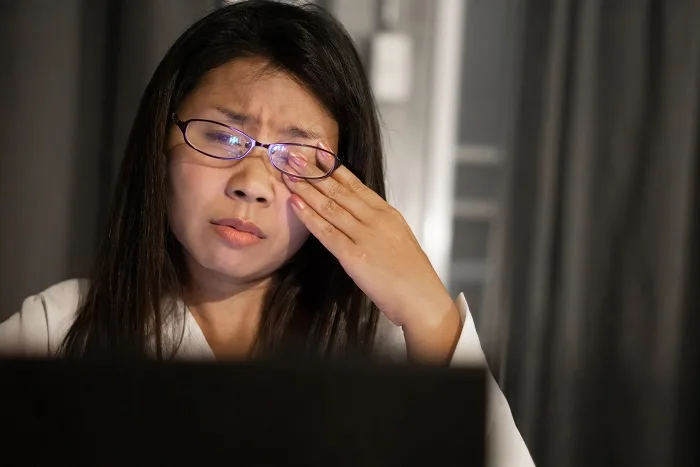
One possible contributor is the modern indoor environment. Heated and air-conditioned rooms, fans blowing toward the face, smoke, air pollution, low humidity, cosmetics, and long stretches of screen use can all increase evaporation from the eye’s surface or destabilize the tear film. If you work at a screen, the goal is not perfection—it is rhythm. Every 20 minutes, look far away, soften your gaze, and perform a few slow, complete blinks.3
Environmental toxins deserve thoughtful attention, but not fear. You do not need to assume every symptom comes from “toxins.” Instead, reduce the exposures we already know can burden the ocular surface: smoke, fragrances or aerosols that sting the eyes, dust, poor ventilation, and direct forced air. Consider a humidifier in a dry bedroom or office, wraparound eyewear outdoors on windy days, and an air purifier if smoke or pollution is a regular issue.
Genetics can also shape susceptibility. You may inherit tendencies toward autoimmune illness, rosacea, allergy, lipid-gland dysfunction, or heightened inflammatory responses. Genetics are not destiny, but they can help explain why one person tolerates a dry climate and screens easily while another develops persistent symptoms.1
Microbiome, Food, and Inflammation
The microbiome—the community of organisms living in and on the body—has become an important area of dry-eye research. Scientists are studying both the gut–eye connection and the ocular-surface microbiome because immune signaling, metabolic health, and inflammation may influence tear-film stability and healing. But this research is still emerging; it does not prove that a microbiome test or a probiotic will cure dry eyes. 4
A more grounded approach is to support the foundations of digestive and metabolic health. In Eastern medicine, the digestive system is often seen as central to making usable nourishment and body fluids. In practical terms, emphasize a varied, minimally processed diet with vegetables, legumes, fruit, adequate protein, nuts, seeds, and fiber-rich whole foods. If you notice that alcohol, very sugary foods, ultra-processed snacks, or heavily fried foods worsen your symptoms or disrupt your sleep, experiment with reducing them.
For some people, low intake of essential fatty acids may be a relevant risk factor, although supplement research is mixed and should not be oversold. Food-first options include fatty fish, walnuts, chia, flax, and hemp seeds. If you are considering omega-3 supplements, especially if you use blood thinners or have surgery planned, discuss it with your clinician. 2
Hydration also matters, but drinking excessive water is not a cure for evaporative dry eye. Think instead about steady hydration, balanced meals, regular sleep, and reducing habits that leave you depleted. From the eastern perspective it’s a deeper level of moisture that hydrating with water will not resolve.
Pathogens and Immune Health
Viruses and bacterial pathogens can affect the eyes, but routine dry-eye symptoms should not automatically be blamed on a hidden infection. Viral infection appears among possible or inconclusive dry-eye associations, and inflammation after infections can sometimes affect the ocular surface. Bacterial lid disease, blepharitis, and an overgrowth of Demodex mites can also contribute to eyelid inflammation and poor meibomian-gland function.2
Movement and Nervous-System Balance
In both Eastern and modern perspectives, stress can amplify symptoms. Dry eye is not “all in your head,” but the nervous system influences blink rate, pain sensitivity, inflammation, sleep, and muscle tension. Long hours of concentrated work can reduce blinking and leave the eyes exposed. 4
Tai chi and Qi Gong can be helpful supportive practices because they encourage slower breathing, posture awareness, gentle circulation, and a shift out of chronic fight-or-flight activation. Choose a simple 10-minute daily practice: stand comfortably, soften the knees, let the shoulders drop, breathe slowly through the nose if comfortable, and move the arms in an easy, unforced rhythm.
You can also add an “eye-rest” practice. Warm your palms by rubbing them together, then cup them gently over closed eyes without pressing on the eyeballs. Take five slow breaths. When you open your eyes, blink fully several times. This does not replace medical treatment, but it can interrupt strain and create a useful pause.
Meditation may serve a similar role. Try five minutes daily: sit comfortably, notice the breath, relax the jaw, forehead, and muscles around the eyes, and let the gaze soften behind closed lids. The intention is not to force tears; it is to reduce the tension and vigilance that can make discomfort feel louder.
### Chinese Herbs and Acupuncture
Chinese herbal medicine may be considered as part of individualized care, particularly when a trained, licensed practitioner identifies a specific pattern such as dryness with heat, fatigue and poor sleep, digestive imbalance, or systemic inflammatory symptoms. Do not assume that common “eye herbs” are universally safe or effective. Herbs can interact with prescriptions, affect bleeding risk, alter blood sugar or blood pressure, and may be inappropriate during pregnancy, breastfeeding, or liver and kidney disease.
Acupuncture has some supportive evidence for improving dry-eye symptoms and tear-film measures, but research quality varies, and it should be viewed as an adjunct rather than a replacement for eye care. If you pursue it, work with a qualified practitioner who communicates with your optometrist or ophthalmologist. 3
A Note on DMSO
DMSO, or dimethyl sulfoxide, is sometimes discussed in alternative-health circles because of its anti-inflammatory and tissue-penetrating properties. Laboratory and review literature suggests it may have potential roles as a component of certain ophthalmic drug formulations, but this is not the same as proving that consumer DMSO is a safe dry-eye treatment.5
Do not put over-the-counter, industrial, oral, or skin-use DMSO into or near your eyes. DMSO can carry other substances through tissue, and high concentrations have been reported to irritate inflamed eyes. If an ophthalmic medication containing DMSO is ever appropriate, that decision should come from an eye specialist using a sterile, regulated formulation—not from self-experimentation.6
A Practical Daily Plan
Start gently and consistently:
– Use preservative-free artificial tears if recommended by your eye-care clinician.
– Apply a warm compress and practice gentle lid hygiene if meibomian-gland dysfunction or blepharitis is present.
– Protect your eyes from wind, smoke, low humidity, and direct airflow.
– Take regular screen breaks, look into the distance, and practice complete blinking.
– Eat in a way that supports stable energy, fiber intake, healthy fats, and lower inflammatory burden.
– Practice 10 minutes of Qi Gong, tai chi, walking, or another calming movement daily.
– Use meditation or breath awareness to reduce jaw, brow, shoulder, and eye-area tension.
– Seek qualified evaluation for persistent symptoms, autoimmune clues, severe redness, pain, light sensitivity, discharge, or vision changes.
The Eastern perspective is most helpful when it broadens the question from “What drop fixes my eye?” to “What conditions help my whole system restore balance?” Use that perspective alongside—not instead of—evidence-based eye care. Be cautious: The practical message is simple: if you have red eyes, crusting, discharge, light sensitivity, eye pain, a sudden change in vision, or symptoms mainly in one eye, seek prompt professional care. Do not self-treat a possible infection with herbs, essential oils, or homemade eye drops.
Click here to set up a zoom call to discuss your goals.
Resources:
1 https://www.tfosdewsreport.org/report-epidemiology_report/71_36/en/
2 https://www.tearfilm.org/dettnews-tfos_dews_ii_patient_summary/6814_5519/eng/
3 https://pmc.ncbi.nlm.nih.gov/articles/PMC12901812/
4 https://crstoday.com/crst-issues/apr-2024/beyond-dews-ii/45268/
5 https://pmc.ncbi.nlm.nih.gov/articles/PMC7555241/
6 https://ohsu.elsevierpure.com/en/publications/effects-of-dimethyl-sulfoxide-on-ocular-inflammation-2/